Learn what to expect on the drive test.
Know before you go
- Only you, an examiner, a service animal, and an interpreter for the deaf or hard of hearing are allowed in the vehicle during the test. Sometimes one of our supervisors or a staff-in-training may ride along as an observer. If you have an objection, please tell us at the start of the test.
- No weapons are allowed in the vehicle.
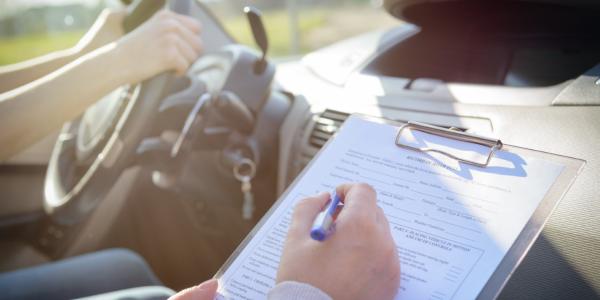
The driving test measures your ability to drive legally and safely. An examiner rides with you to evaluate your driving. They won't try to confuse, trick, or ask you to do anything illegal.
Before your test begins
There are a few things you can expect before your driving test can begin:
- We will need to see proof of current liability insurance.
- We will check your vehicle to make sure it’s in good working order.
Proof of current liability insurance
The document needs to state the:
- Name of the policy holder.
- Vehicle description.
- Dates the policy begins and ends.
The examiner conducting your exam cannot verify proof of insurance by phone. Any delay in providing current liability insurance may result in rescheduling your appointment.
Vehicle safety check
The examiner will check your:
- Brake lights (including the center light).
- Turn signals.
- Seat belts (must lock and unlock properly).
- License plate (must be valid).
- Parking brake.
- Windshield (checked for any items or cracks that impair safe vision).
- Passenger door (must open and close from the inside and outside).
- Driver’s door window (must roll down far enough to allow you to use hand signals).
- Mirrors (the law requires outside left and inside rearview or outside left and outside right).
- Windshield wipers, headlights, and defrosters (if weather requires use).
If any vehicle equipment is not working, the examiner will not conduct your drive test.
What the test includes
Below is a list of what we will test you on once you're behind the wheel:
1. Starting your vehicle
2. Leaving the curb
- Signal and wait until it's safe to re-enter traffic
3. Controlling the vehicle
- Use the gas pedal, brake, steering wheel, and other controls correctly
- Change your speed to meet:
- The number and speed of other vehicles and pedestrians
- Road and weather conditions
- Construction
- Amount of light
- The distance you can see ahead
4. Driving in traffic
- Use the proper lane
- Signal to change lanes
- Change lanes carefully
- Follow other vehicles at a safe distance
- Turn your head and look back before changing lanes
- Signal the proper distance before turning
5. Obeying traffic signals and signs
- Turn into the proper lane without cutting the lane or going wide into the improper lane
- Scan carefully for signs, signals, pedestrians, and other vehicles, yield, and take the right-of-way correctly
6. Driving through blind or crowded intersections
- Scan carefully for signs, signals, pedestrians, and other vehicles
- Yield and take the right-of-way correctly
7. Stopping
- Stop smoothly and at the right spot
- Stop quickly and safely in an emergency
8. Backing up
- Look over your right shoulder
- Back in a straight line
- Have complete control of your car
9. Judging distance
- Stay a safe distance away from:
- Other cars when following or passing
- People walking or riding on the roadway
10. Respectful driving
- Be courteous to other drivers, pedestrians, and bicyclists
- Pay full attention to the driving task
11. Performing specific maneuvers
- Arm signals for right/left turn and slow or stop (you may use your arm signals during the test)
- A brake reaction test/emergency stop: you will be asked to put your foot on the gas pedal and step on the brake as fast as possible when told to stop
- Parking on a hill: you will park as if you were going to leave your car there unattended
- Parallel parking: you will parallel park without parking assist features on your vehicle
- Simulating backing out of a driveway or alley into traffic using a corner: you will be directed to back your vehicle around the corner to the right, staying as close to the street as you can, and continue backing in a straight line until directed to stop.
Be prepared
Here are some tips for making sure you are prepared for your test.
- Study the Washington Driver Guide, and, above all, practice. Remember, you need to practice with a licensed driver.
- You should be comfortable driving in all traffic situations. Know the rules of the road and obey them. Test in a vehicle you are familiar with.
- Like most people, you might be a little nervous about taking the test. If you have practiced and remember the driving tips listed here and in the Driver Guide, you have a good chance of passing on the first try.
- Drive safely and good luck!
Drive test videos
Prepare for your drive test with our short video series below to learn what to expect:
- Drive Test 1: Pre-test
(2 min 56 sec) - Drive Test 2: Backing maneuver
(2 min 17 sec) - Drive Test 3: Parallel Parking
(2 min 26 sec) - Drive Test 4: Lane change and turning
(1 min 48 sec)
New Driver Toolkit (printable)
Use the printable pages below to take along and practice your driving skills.